
How to Delete All Your Tweets: Bulk & Mass-Delete Methods
Twitter (X) gives you exactly one native way to remove a tweet: open it, tap the menu, choose Delete, confirm. There is no select-all checkbox, no “delete all tweets” button hiding in the settings, and no official bulk option of any kind. So the honest answer to “how do I delete all my tweets?” comes down to two paths: delete them manually one by one, which is fine for a few dozen posts, or hand the repetitive part to a bulk deletion tool.
One warning before the step-by-step. Much of the advice you will find about mass deleting tweets predates 2023, the year X moved its API behind expensive paid tiers. The free web deleters that older articles recommend were built on cheap API access; when that disappeared, they shut down, moved behind subscriptions, or quietly capped their free plans at a small batch of recent tweets. An on-device app avoids that squeeze entirely — it signs in on your phone the way you do and deletes tweets the way you would manually, so X’s API pricing never enters the picture. This guide covers all of it: single deletes, full wipes, clearing old tweets by date, and what deletion does and does not remove.
First, the Basics: Deleting a Single Tweet
Worth thirty seconds, because every method below is ultimately this one action repeated.
In the X app (iOS or Android):
- Open the X app and tap your profile picture.
- Find the tweet on your profile.
- Tap the three-dot menu on the tweet.
- Tap Delete.
- Tap Delete again to confirm.
On the web:
- Go to x.com and open your profile.
- Scroll to the tweet you want gone.
- Click the three-dot icon on the tweet.
- Click Delete, then confirm.
The removal is immediate and permanent — X has no trash folder and no undo. It is also the entire native toolkit. At roughly ten seconds per tweet, a 3,000-tweet account works out to more than eight hours of uninterrupted tapping, which is exactly why bulk tools exist.
How to Delete All Tweets: The Two Realistic Paths
Manual deletion: fine under about 50 tweets
If your account holds a few dozen posts, skip the tooling question entirely. Open your profile, work from the top, and repeat the steps above until the timeline is empty. Check the Replies and Media tabs on your profile too — posts hide there that the main feed does not surface. No third-party access, no caps, no cost beyond a coffee break’s worth of tapping.
Bulk deletion: how everyone else does it
Past about fifty tweets, manual deletion stops being a plan and starts being a punishment. Bulk tools fall into two families. Web-based deleters run in your browser and connect through X’s paid API — workable, but they inherit X’s API costs, which is why their free tiers are capped and the genuinely useful features (date filters, big batches, archive support) usually sit behind subscriptions. The other family runs on your device. Our guide to choosing a tweet deleter compares the whole landscape in detail if you want the full tour.
Unpost takes the on-device route. It is a mobile app for iOS and Android that bulk deletes your own tweets straight from your phone: it signs in through the regular X web login, keeps the encrypted session on your device, and removes tweets exactly the way you would manually — one at a time, at a pace that respects X’s rate limits. Date-range and keyword filters decide what goes, and the same app also cleans up Reddit, Discord, Instagram, and Slack. Here is the whole job:
-
Install Unpost on your iPhone or Android phone from the App Store or Google Play.
-
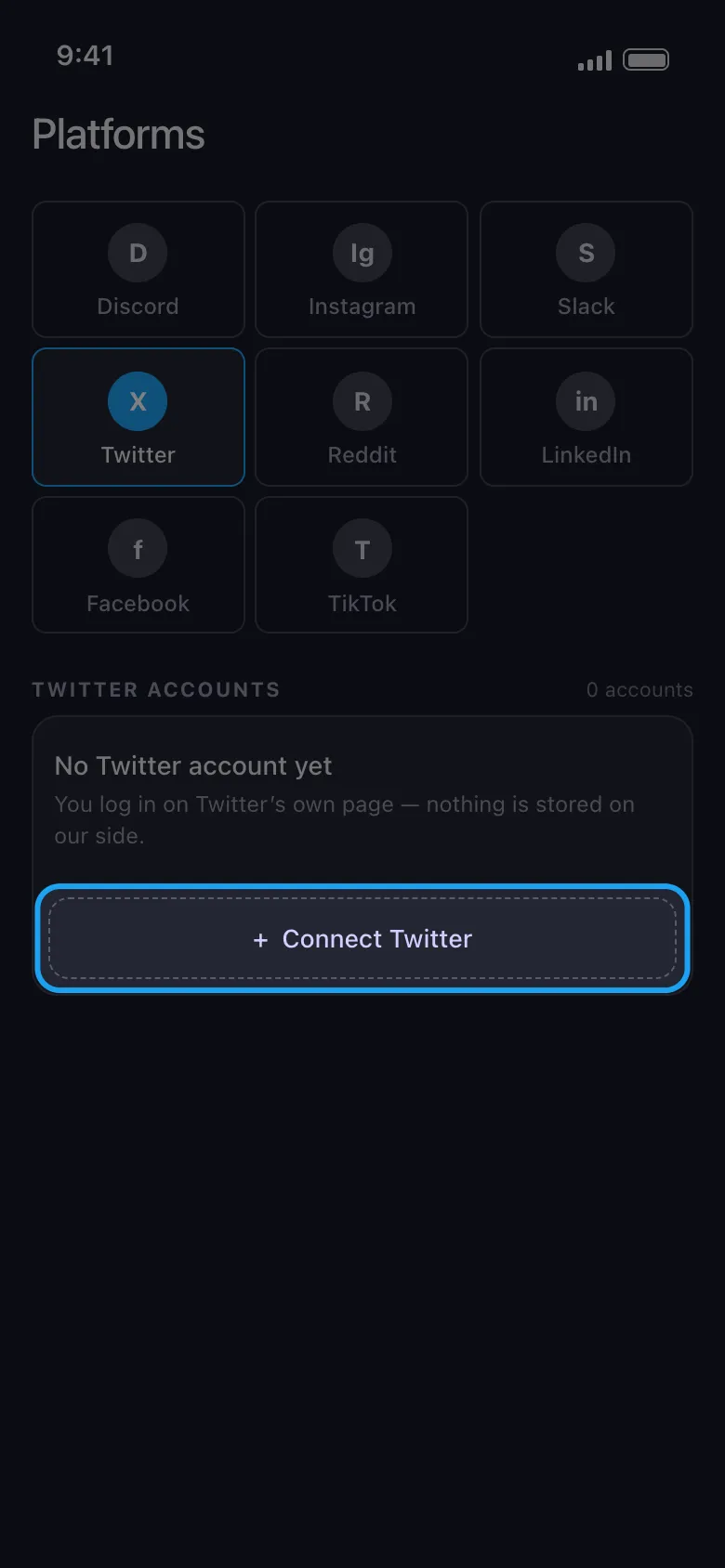
Connect your Twitter (X) account through the normal X web login inside the app — no password shared, no API key, nothing pasted into a website.
-
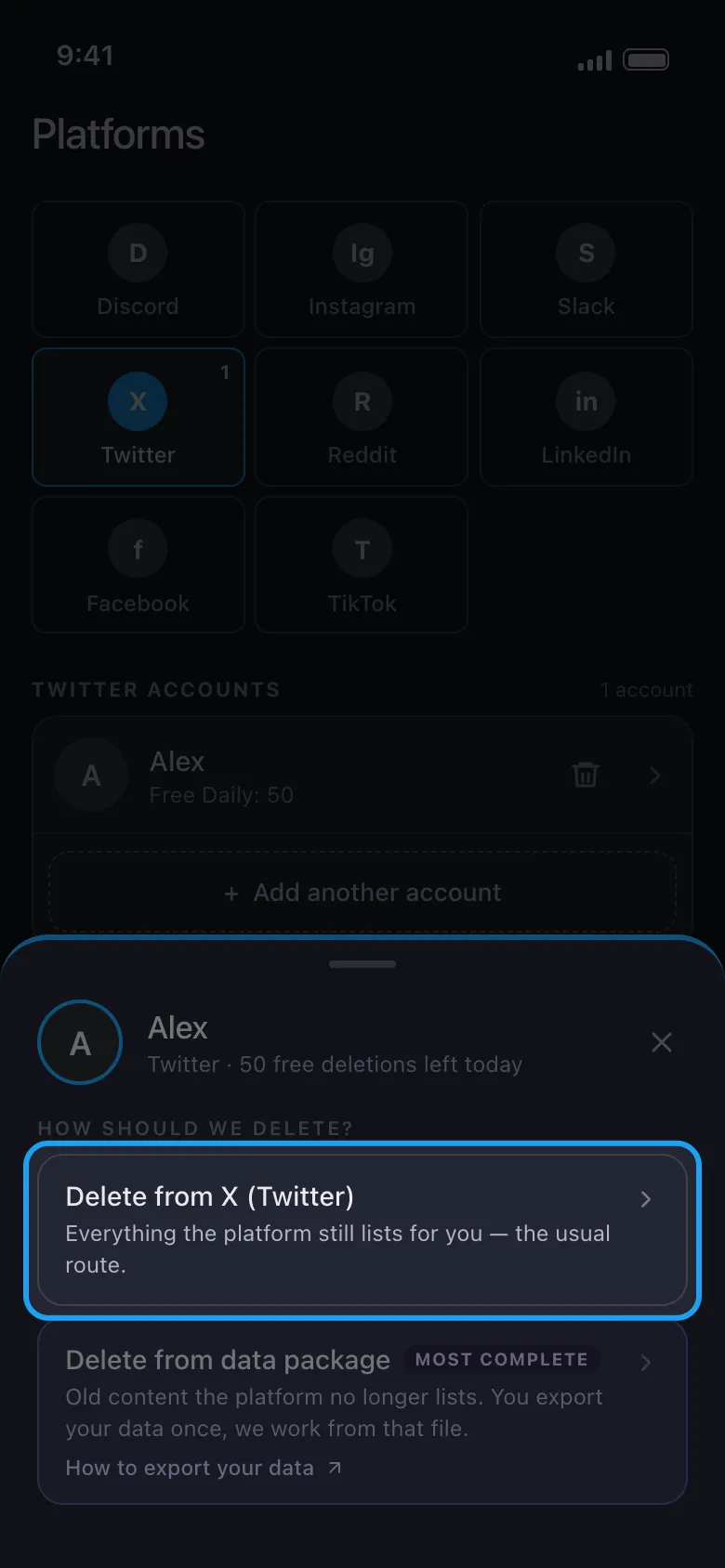
Set your scope. Leave the filters open to select everything, or narrow the run by date range or keyword.
-
Review the selection and deselect anything you want to keep. For a true delete-everything run, this is your last look.
-
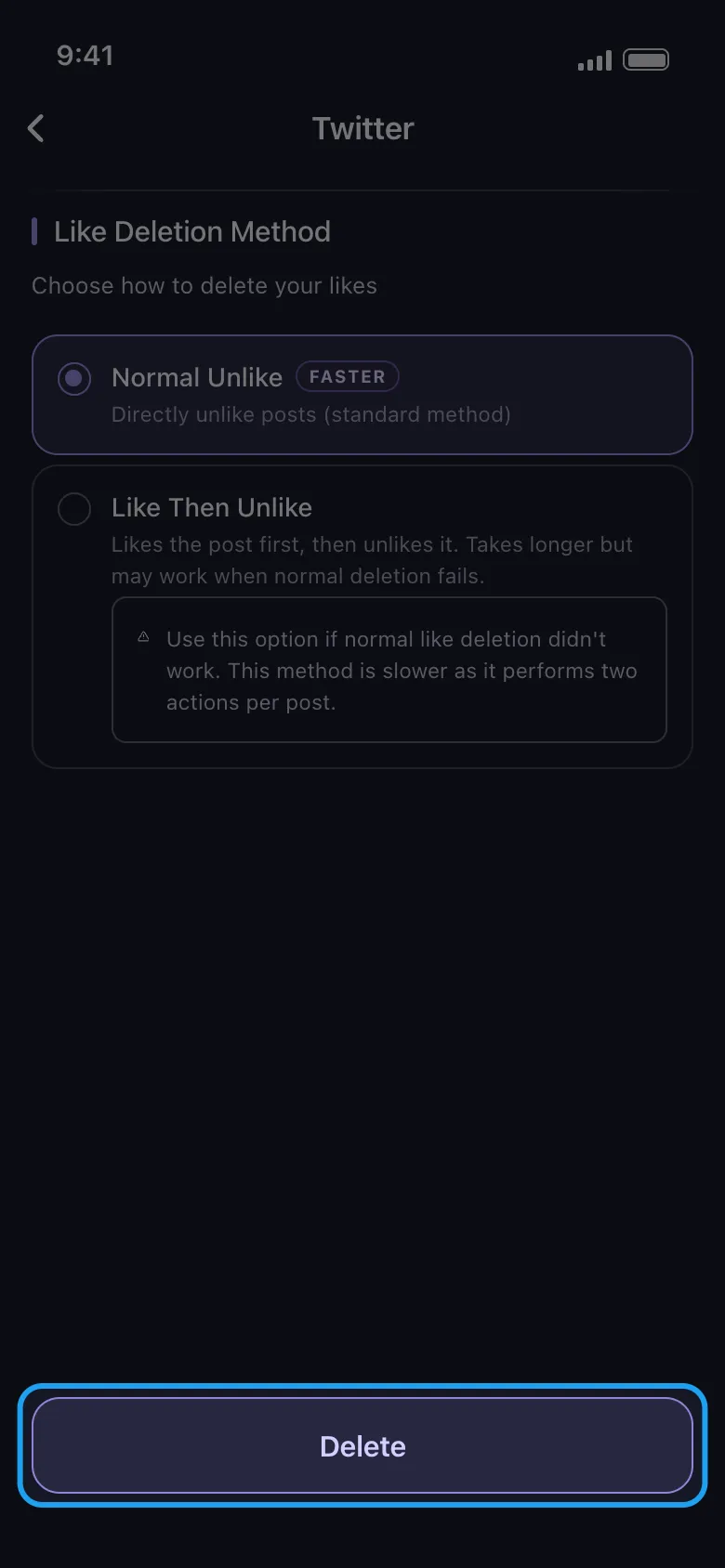
Start the cleanup and keep Unpost open in the foreground while it works through the list. Thousands of tweets take a while by design — manual-speed pacing is what keeps the run safe.
Wipe Your Timeline
Delete all your tweets without handing over your password.
Unpost signs in on your device through the regular X web login and mass-deletes your tweets the way you would manually — with date and keyword filters for the history you want to keep.
The free plan includes a daily deletion allowance — enough to clear a modest account over a few days and to see the workflow end to end before deciding whether premium, which removes the cap, is worth it for a bigger backlog.
Deleting Old Tweets by Date
Plenty of cleanups are not “everything must go” but “2014 me must go”. Old tweets resurface at the worst possible moments — a hiring manager scrolling deep into your profile, a new audience finding a joke that aged badly, a decade-old argument presented as your current opinion. Deleting old tweets by date keeps the account and your recent voice while retiring the era that no longer represents you.
Two habits make a by-date cleanup work:
Think in slices, not one giant pass. “Everything before 2020” or “the 2016–2017 stretch” is easier to review and easier to verify than a single wipe of half your history. In Unpost that is one date-range filter per pass: set the range, scan the selection, run it, move to the next slice.
Download your archive first. Request it under Settings and privacy, then Your account, then Download an archive of your data; it arrives within a day or two as a browsable file of everything you ever posted. It tells you what you are actually about to delete — most people have no idea what lives in their 2013 — and it doubles as a personal backup, because once tweets are deleted there is no recovering them from X.
The archive matters for a second reason: visibility. X’s timeline simply stops serving very old posts at some point, so tools that rely on standard timeline access typically reach only your most recent few thousand tweets. Web deleters work around this by having you upload that archive to their servers so they can locate old tweet IDs — it works, but it adds a multi-day detour and hands your complete posting history to a third party along the way.
What Deleting Tweets Does Not Remove
Deleting a tweet removes it from X: it leaves your profile, drops out of X’s search, and quote tweets of it stop displaying your text. A complete cleanup plan should still account for what survives.
Copies made by other people. Screenshots are forever, and no tool on earth reaches into someone else’s camera roll. The commentary on a quote tweet stays up even after your quoted post goes blank, and third-party archive sites may hold snapshots of public pages. None of this is a reason to skip deleting — it is a reason to delete sooner, because a post that is gone cannot be screenshotted next year.
Search-engine caches. Google and Bing keep cached copies of indexed pages for a while, so a deleted tweet can still surface in search results for days or weeks after it is gone from X. These fade out on their own as crawlers revisit; no action needed, just patience.
The rest of your footprint. Your likes still sit on other people’s posts, your retweets of other accounts keep amplifying them until you undo each one, and the replies you dropped into other people’s threads are their own pile — replies are tweets, so a full wipe includes them, but a filtered pass might not. Each of those is a separate cleanup task that follows the same logic as this one.
Deactivating vs Deleting Tweets
A tempting shortcut: if deleting every tweet takes work, why not just deactivate the account? Because deactivation and deletion do different jobs.
Deactivation is an account-level switch. The moment you deactivate, your profile and every tweet disappear from public view — but nothing is deleted yet. X holds the account in that hidden state for 30 days, and logging in during that window restores everything exactly as it was, tweets included. Only after the window passes is the account permanently erased: handle, followers, and DMs along with it.
Deleting tweets removes the content while keeping the account. Your handle stays yours, your followers stay put, your DMs survive, and your timeline is simply clean.
So the choice maps to your goal. Leaving X for good? Deactivate and let the 30 days run out — though many people bulk-delete their tweets first, since the content sits recoverable on X’s side until the deadline passes. Staying on X with a fresh slate, or keeping your username from ever being recycled? Delete the tweets and keep the account. Deactivation is not a tweet-deletion method; it is an account-deletion method on a delay.
Manual vs Free Web Tools vs Unpost
| Manual deletion | Free web deleters | Unpost | |
|---|---|---|---|
| Coverage | Every tweet in theory; realistic up to ~50 | Free tiers capped at a small recent batch; old tweets need an archive upload | Full timeline from your phone, with a review step before deleting |
| Cost reality | Free, paid in hours of tapping | ”Free” until the cap, then a subscription — they inherit X’s API costs | Free plan with a daily limit; premium removes the cap |
| Safety | Nothing to connect | Account access granted to a third-party server; the worst ones ask for passwords or tokens | Signs in on-device; encrypted session never leaves your phone |
| By-date filters | You, scrolling | Commonly a paid feature | Date-range and keyword filters built in |
The pattern is consistent: manual wins for tiny accounts, web tools demo the job on a small batch and charge for the rest, and an on-device app does the whole thing from your pocket without your credentials going anywhere.
Before You Hit Delete
A full wipe is permanent, so order matters: download your archive first, decide whether this is a delete-everything run or a by-date trim, review the selection before any batch starts, and remember that likes and retweets are their own chores afterward. If you want the bigger picture on why a smaller public footprint pays off — well beyond any single awkward tweet — the rundown of essential privacy tools makes that case in practical terms.
However you arrived here — job hunt, fresh start, or plain digital tidiness — the job itself is straightforward. Under fifty tweets: do it by hand today. Anything more: get Unpost and let your phone do the tapping for you.
Frequently Asked Questions

Get Started
Delete Old Content Across Your Accounts
Bulk delete messages, posts, likes, comments, DMs, reactions, bookmarks, followers, and more — all from one app.
No password storage • Free to start • iOS & Android
 Download for iOS
  Download for Android